
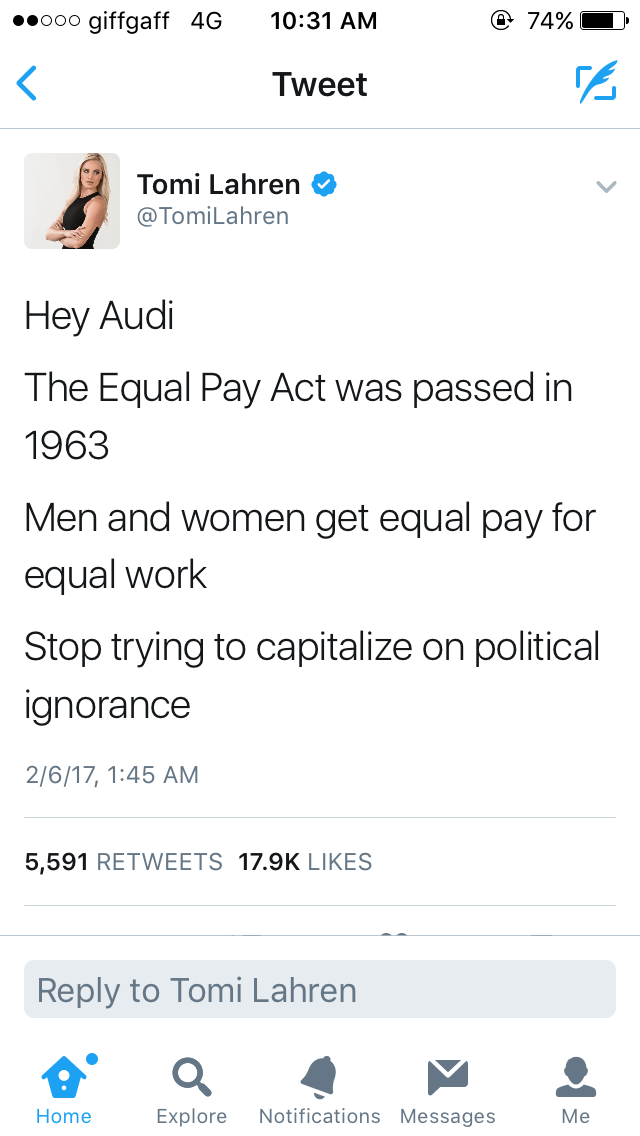
So Tomi Lahren posted this gem on Twitter earlier this week.
Let’s break this down.
First, the facts.
Yes, the Equal Pay Act was passed in 1963, during the Kennedy Administration. You can read it here (https://www.eeoc.gov/eeoc/history/35th/thelaw/epa.html), but to sum it up pretty simply, it states that employers cannot discriminate between employees of different genders when it comes to paying wages. To use Tomi Lahren’s words (ugh), “equal pay for equal work.”
She’s right that the Act was passed. That’s what the Act was supposed to do. But has it worked?
Not by a long shot. Let’s look at the numbers.
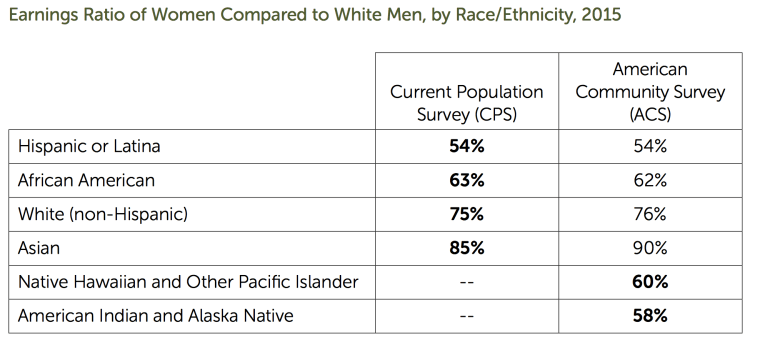
The wage gap certainly has narrowed since the Equal Pay Act was passed, largely due to more women going to college and getting a higher education, as well as the fact that the number of women in the workforce has significantly increased. However, the gap still persists. Statistics show that among full-time, year-round workers, a woman is paid 78 percent of what a white man was paid (White men are used as the benchmark because they make up the greatest percentage of the workforce (Hallman et al. 2015). Some states are better (in Washington DC, the gap is 91 percent) and some are worse (in Louisiana, the gap is around 65 percent (Hallman et al. 2015). The pay gap is worse for women of color. The salary of an Asian-American woman shows the smallest gender pay gap, at 90 percent of a white man’s earnings (Hallman et al. 2015). A Hispanic woman’s salary shows the largest gap, at 54 percent compared to that of a white male (Hallman et al. 2015).
Here’s a chart on earning ratios of women compared to white men by race and ethnicity:
(Source: The Simple Truth about the Gender Pay Gap, 2017 Edition).
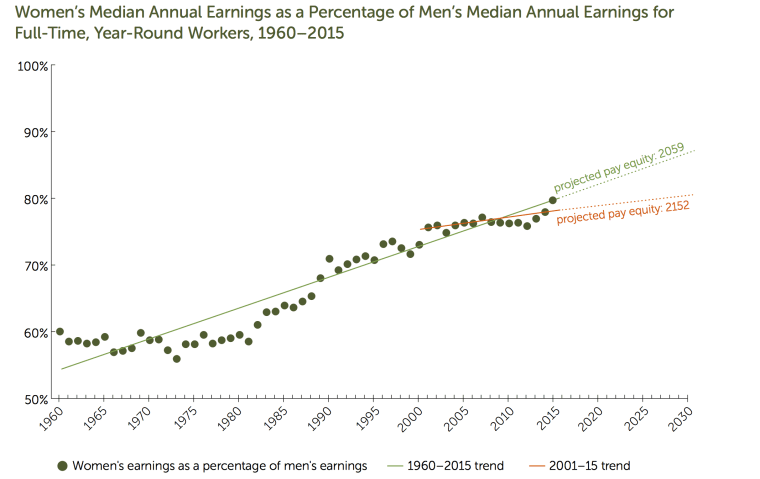
A more recent study has claimed that at the rate of change between 1960 and 2015, women are expected to get equal wages as men in 2059 (Ho et al. 2017). However, progress has stalled in recent years – at this rate, women will not reach pay equity with men until almost 100 years after that, in 2152 (Ho et al. 2017.).
Here’s a chart that reflects the rate of change towards equal wages:
(Source: The Simple Truth about the Gender Pay Gap, 2017 Edition).
Disability status is a difficult population demographic to capture because it covers such a broad range of definitions. The ACS measures disability in six categories: hearing, vision, cognitive, ambulatory, self-care, and independent living (Ho et al 2017). According to the ACS, in 2015, people with disabilities made only 68 percent of what people without disabilities made. The gender pay gap, furthermore, is substantial – women with disabilities earned just 69% of what men with disabilities made (Ho et al 2017).
Sexual orientation and gender identity is another interesting demographic to study. Gay and bisexual men are paid 10-32% less than of similarly qualified heterosexual men (Ho et al 2017). That same study also found that while lesbian women may be paid more than heterosexual women, lesbians are still paid less than heterosexual or gay men (Ho et al 2017). When analyzing the pay gap, it is important to recognize people who do not identify with the gender they were born with. A study found that transgender people who transitioned from male to female experienced a significant drop in pay post-transition, while those who transitioned female to male experienced little to no increase in pay (Ho et al 2017). This can be tied back to how transgender people unfortunately receive a lot of harassment and discrimination within the workplace.
What people often don’t realize is that the gender pay gap follows women into retirement. Because women are paid less than men during the years that they work, when they retire, women receive less income from Social Security, pensions, and other potential sources than retired men do (Ho et al. 2017). Furthermore, certain disability and life insurance benefits are also smaller for women because these benefits are based on earnings (Ho et al. 2017).
PSA: By the way, all of this data is coming from various U.S. government bureaus, including the U.S. Bureau on Labor Statistics and the U.S. Census Bureaus. No #alternativefacts here.
That’s all for today! I promise I’ll blog about Oxford again in a few days!
Much love,
Tasha
Works Cited:
Hallman, Linda et al. 2015. “The Simple Truth About The Gender Pay Gap.” American Association of University Women. 2015 Edition:1-26
Ho, Patricia Fae et al, 2017. “The Simple Truth About The Gender Pay Gap.” American Association of University Women. Spring 2017 Edition:1-30.
 Perspectives
Loved it. She is a troll and an airhead. Love. Mama